The Evolving Landscape of Education in India
A Deep Dive Into Curricula, Methodologies & Emerging Trends (2025)
METHODOLOGIES
4 min read
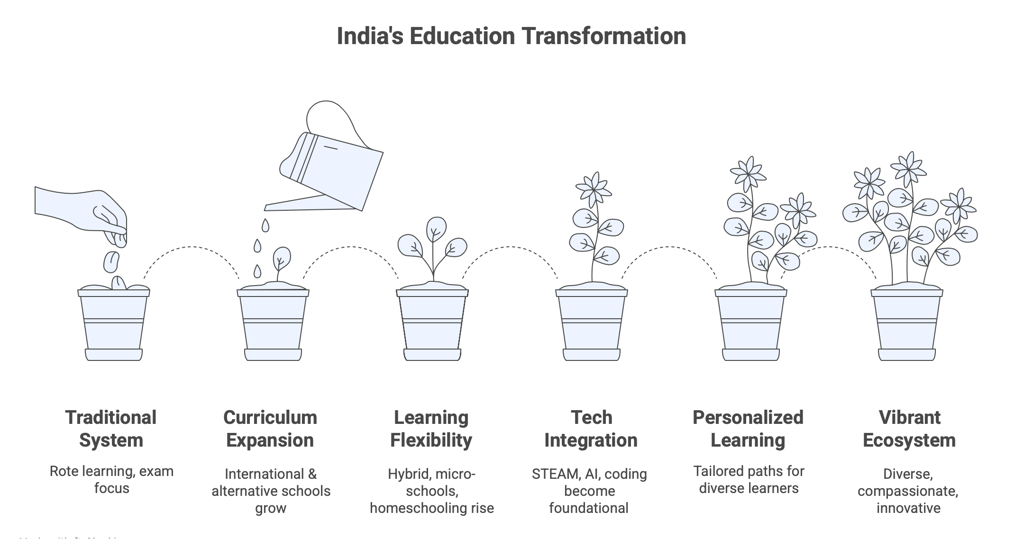
India stands at a remarkable crossroads in its educational journey. What was once a largely standardised, exam-driven system has blossomed into one of the world’s most diverse learning ecosystems rich, layered, and full of possibility. From international curricula shaping global citizens to alternative pedagogies nurturing mindful, creative, and self-directed learners, parents today have more meaningful choices than ever before.
This blog unpacks the complete landscape of India’s educational methodologies and boards, and the powerful shifts shaping the future of learning, helping families make informed, aligned, heart-led choices for their children.
1. The Pillars of Indian Schooling: Mainstream Boards
For decades, mainstream boards have formed the backbone of India’s school system. Their reach, structure, and familiarity make them the default choice for millions.
CBSE: The National Favourite: The country’s largest national board, CBSE offers a uniform curriculum that aligns closely with competitive exams like JEE and NEET. Its strength lies in standardization and transferability, ideal for families on the move.
ICSE/CISCE: The Language-Intensive, Analytical Pathway: ICSE schools are known for their detailed curriculum, strong emphasis on English, and a balanced approach that nurtures analytical skills alongside humanities and sciences.
NIOS: Flexibility at Its Finest: The National Institute of Open Schooling is quietly reshaping possibilities. With no mandatory attendance, flexible subject choices, and vocational pathways, NIOS empowers learners who need freedom and space. It has become a lifeline for sportspersons, artists, neurodiverse learners, and homeschooling families.
2. Rising Popularity of International Curricula
As aspirations shift towards global mobility, international boards have witnessed exponential growth.
Cambridge (IGCSE): Known for its broad subject offerings and inquiry-driven approach, IGCSE encourages students to think critically and apply knowledge in real-world contexts.
IB (International Baccalaureate): The gold standard for holistic, inquiry-based learning IB nurtures independent thinkers, reflective learners, and compassionate global citizens. With PYP, MYP, and DP programs, it offers a seamless school journey grounded in exploration and research.
Edexcel: A modular, flexible UK-based pathway, widely recognized by global universities. International curricula are expanding rapidly beyond metros to cities like Jaipur, Coimbatore, Pune, and Nagpur, signifying changing aspirations and rising access.
3. State Boards: The Heartbeat of India’s Education System
Despite the spotlight on alternative and international models, state boards continue to educate the majority of Indian children with 75–80% of students enrolled in government or regional-language schools. Affordable, accessible, and deeply embedded in local contexts, they remain a vital part of India’s educational fabric.
4. Alternative Education: The Movement Redefining Learning
A quiet revolution is underway. Thousands of families and progressive schools are shifting focus from rote-driven schooling to child-led, experiential, and holistic learning models.
Montessori: Hands-on, self-directed exploration in beautifully designed environments. Particularly powerful in early childhood, Montessori learning nurtures independence, concentration, and joyful discovery.
Waldorf/Steiner: Flowing rhythms, seasonal learning, arts-led immersion, and delayed academics create emotionally grounded, imaginative learners.
Reggio Emilia: A unique blend of project-based exploration, expressive arts, and a deeply thought-out learning environment. Every child is seen as capable, curious, and full of potential.
Krishnamurti Schools: Centred on mindfulness, inner freedom, and inquiry, these schools create spaces where learning is unhurried, meaningful, and deeply reflective.
Democratic & Sudbury Schools: Where children choose what, how, and when to learn and participate as equals in school governance.
These schools foster self-direction, responsibility, and authentic confidence.Ecological & Integral Education: Inspired by Sri Aurobindo or ecological pioneers like Satish Kumar, these schools weave sustainability, yoga, arts, and community living into the curriculum.
Homeschooling & Unschooling: More than 10,000 families in India now choose home-based, interest-led, flexible education. Many adopt NIOS for certification, while others lean fully into unschooling. The rise is staggering almost 300% growth in the last decade.
Micro-Schools & Hybrid Learning Hubs: Emerging as the newest frontier, these small, personalized, community-led learning spaces blend online and offline experiences ideal for families looking for high flexibility and deep personalization.
5. The Methodologies Shaping Indian Classrooms
Across mainstream and alternative systems, schools are adopting innovative methodologies:
Game & Play based learning or Gameschooling
Project-Based Learning (PBL)
Inquiry-Based Learning
Experiential Learning
Multiple Intelligences
Hybrid/Flipped Classrooms
Social-Emotional Learning (SEL)
Reflective Practices
Gurukulams
These pedagogies represent a collective shift toward deeper understanding, creativity, collaboration, and emotional well-being.
Key Trends Redefining Education in India (2025)
International Curricula Growing at Record Speed: IB has surged by 43% in just a few years, and Cambridge schools continue to expand aggressively.
Alternative Schools Moving Mainstream: Alternative education methodologies are seeing rapid growth, especially in urban centres.
Preschool Market Booming: With rising awareness of early childhood development, the preschool sector is projected to grow to ₹80,000+ crores.
Flexibility in Learning Is No Longer Optional: NIOS, hybrid models, and micro-schools are increasingly embraced as valid and empowering pathways.
Homeschooling on the Rise: Families are stepping away from pressure-heavy systems to craft personalized, emotionally nourishing learning journeys.
Technology, AI & Skills-Centric Learning: STEAM, AI literacy, maker spaces, coding, and vocational training are becoming foundational pillars of education.
Socioeconomic Segmentation Deepening: A clear three-tier education structure premium, mid-range, affordable is taking shape, influencing equity and access.
Choosing the Right System for Your Child
In this wide and dynamic landscape, the “best” education system is the one that aligns with
Your child’s learning style
Your family’s values
Financial capacity
Career aspirations local or global
Your child’s need for structure or freedom
What’s most inspiring is that India now offers meaningful pathways for every kind of learner: the highly academic, the creative, the sensitive, the self-directed, the neurodiverse, and the wildly curious.
A New Era of Possibility
The transformation underway is nothing short of extraordinary. A decade ago, conversations centred on marks, boards, and entrance exams. Today, we’re discussing:
Agency
Emotional well-being
Purposeful learning
Global citizenship
Sustainable futures
Personalized pathways
Cultural pride & identity
India’s education system is not just evolving it is expanding into a vibrant ecosystem that honours the uniqueness of every child. The future of education here is diverse, compassionate, innovative, and full of promise.